

Drilling is often the point where an otherwise efficient panel furniture line slows down. Cutting and edge banding may run continuously, but panels still need accurate holes on both faces and four edges for hinges, dowels, shelf pins, drawer slides, and knock-down fittings. If operators must flip, measure, and reposition every board, the process adds labor and creates more opportunities for wrong orientation, damaged surfaces, and mismatched holes.
Six-sided CNC drilling addresses that bottleneck by completing face and edge machining in one controlled cycle. For a furniture manufacturer, however, the important question is not simply what the technology is. The real questions are whether it fits the factory's products, whether it can read existing design data, how it connects with upstream equipment, and which machine configuration can meet the required output without unnecessary investment.
What Six-Sided CNC Drilling Actually Does
A CNC 6-sided drilling machine processes the top, bottom, front, back, left, and right sides of a rectangular furniture panel without requiring an operator to turn the panel manually between operations. Depending on its configuration, the machine can produce vertical holes, horizontal holes, blind and through holes, hinge holes, grooves, and features for dowels, cam locks, and invisible connectors.
"Six-sided" describes the surfaces that can be processed; it does not mean the machine is a six-axis machining center. This distinction matters. Six-sided drilling is optimized for repeatable panel work, while a general woodworking CNC machine or PTP center may offer more freedom for irregular profiles and complex routing. A furniture factory should choose according to its actual parts rather than the number of functions listed in a brochure.
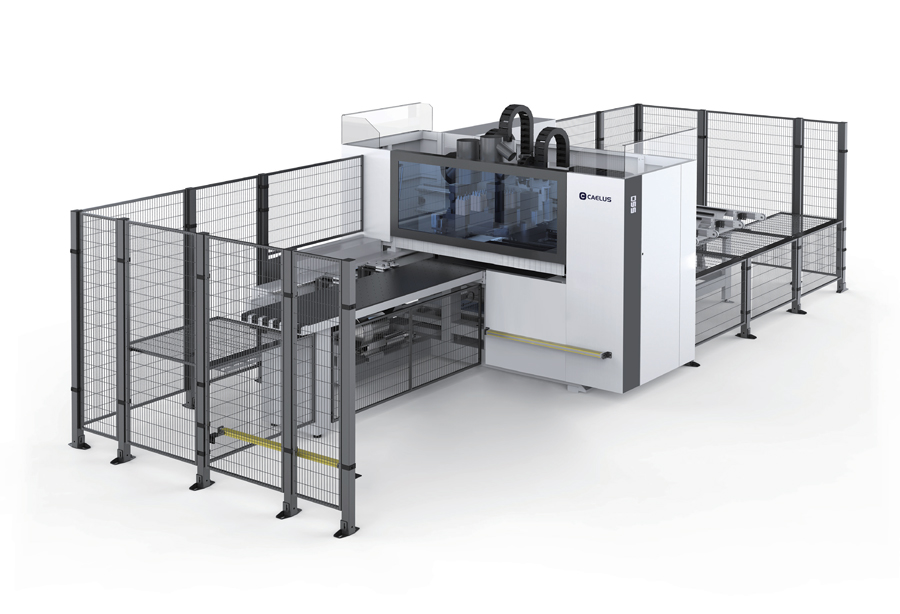
The Six-Sided CNC Drilling Process
1. Panel Data Is Prepared
The process begins before the board reaches the drill. Furniture design or CAD/CAM software generates the panel dimensions, hole positions, depths, grooves, and machining instructions. Each panel receives an identifying barcode or QR code after cutting or labeling.
Software compatibility must be confirmed during machine selection. For example, the Caelus D5A automated drilling center supports CAD/CAM workflows and DXF, MPR, and XML files. A buyer should still send real production files for testing because a supported file extension does not automatically guarantee that every layer name, machining rule, or post-processor will work correctly.
2. The Barcode Calls the Correct Program
At the infeed, the scanner reads the panel ID and calls the associated machining program. This removes manual program selection from normal production and supports mixed orders in which consecutive panels have different dimensions and hole patterns.
The exception process is just as important as the normal one. A good system must respond predictably to unreadable labels, duplicated codes, missing programs, or panels outside the permitted size. The D5A uses long-range barcode scanning and can return a misread panel or release an abnormal panel with an alarm, helping prevent one data error from stopping the whole line.
3. The Panel Is Positioned and Clamped
Grippers and side-positioning devices establish the panel reference. The machine then moves the workpiece through the machining area while maintaining a stable grip. Air-flotation support reduces friction and helps protect laminated surfaces during transfer.
Panel condition remains important. Excessive bow, damaged edges, incorrect edge-banding thickness, or dimensions that differ from the design file can affect the finished hole position. Automation improves repeatability, but it cannot correct inaccurate upstream cutting or incorrect production data.
4. Faces and Edges Are Machined
Upper and lower drilling units process the two broad faces, while horizontal drills machine the four edges. Routing spindles or optional saw units can add grooves and selected milling operations. Multiple tools may work during the same cycle, but actual cycle time depends on the hole pattern, panel length, tool changes, and how efficiently the program distributes work between drilling heads.
The Caelus D5S six-sided drilling center, for example, uses two upper drilling blocks with 26 vertical and 18 horizontal tools, plus a lower block with nine vertical tools. Its published panel range is 200–2,800 mm in length, 50–1,220 mm in width, and 9–60 mm in thickness. These figures are useful for an initial fit check, but the smallest drawer part and the largest cabinet side in the buyer's own product mix should still be physically tested.
5. Finished Panels Move Downstream
After machining, the panel leaves the working area for inspection, sorting, hardware insertion, assembly, or packing. In an automated line, the drilling center normally sits after cutting and edge banding and before assembly. Matching conveyor height, infeed direction, barcode conventions, and production data is therefore as important as selecting the drilling unit itself.
Where the Technology Creates the Most Value
Kitchen Cabinets
Cabinet sides and partitions often combine hinge holes, shelf-pin rows, dowel holes, drawer-slide mounting points, and edge connections. Processing these features from one reference reduces the risk that face holes and edge holes will not meet correctly during cabinet assembly.
Wardrobes and Closet Systems
Wardrobe production involves long panels, repeated 32 mm hole patterns, and many order-specific dimensions. Automatic program retrieval allows different wardrobe components to move through the same line without manual ruler settings between parts.
Flat-Pack and Modular Furniture
Knock-down furniture depends on repeatable connector positions because final assembly may happen outside the factory. A misplaced cam-lock or dowel hole creates a customer-facing problem, not merely an internal rework task. Six-sided processing is particularly useful when the same fittings must align across large batches.
Custom and Batch-Size-One Production
Six-sided drilling is not limited to mass production. Barcode-driven program changes can also support one-off panels, provided the design-to-machine data flow is reliable. For custom work with extensive irregular routing, however, a PTP machining center may remain the better tool. Many factories use both technologies for different part families.
Six-Sided Drilling Compared with Common Alternatives
| Equipment | Best suited to | Main limitation |
|---|---|---|
| Manual or multi-boring machine | Low-volume, repeated hole patterns | More handling and limited flexibility |
| Side-hole drilling machine | Panels that mainly need edge holes | Does not replace full face processing |
| Nesting router | Cutting, face holes, and shaped parts | Edge drilling may need another process |
| PTP machining center | Complex and highly varied machining | More repositioning may be required |
| Six-sided drilling center | Rectangular panels needing face and edge holes | Higher investment and data-integration requirements |
The best choice depends on where the existing bottleneck occurs. A factory that only needs a few horizontal holes may not justify a complete six-sided solution. A line producing hundreds of rectangular cabinet components with holes on multiple surfaces has a much stronger business case.
How to Choose the Right Configuration
Start with production data, not maximum axis speed. Prepare a sample set containing the smallest part, largest part, most common panel, and most complex hole pattern. Ask the supplier to report the complete time from barcode reading to finished-panel discharge. Rapid travel speed alone is not a reliable panels-per-hour figure.
Next, decide how much automation is necessary. Caelus currently offers three practical levels within its CNC six-sided drilling range:
- D5S CNC 6-Sided Drilling Center: a flexible standalone center with twin upper drilling blocks and a five-position tool magazine, suitable for varied machining and step-by-step automation.
- D5A CNC Automated 6-Sided Drilling Center: an automated single-channel solution with a 2+1 drilling arrangement, 53 tools, barcode exception handling, and front-in/rear-out line connection.
- D6A CNC Dual Channel 6-Sided Drilling Center: a dual-channel system with six coordinated drilling heads and simultaneous multi-panel processing for factories where sustained throughput is the priority.
Also check available floor space, maintenance access, electrical supply, compressed air, dust extraction, operator training, spare parts, and remote support. The installed project cost includes much more than the machine itself: conveyors, safety fencing, software interfaces, tooling, shipping, commissioning, and production ramp-up all belong in the budget.
How to Verify Accuracy and Return on Investment
Avoid treating a single positioning specification as a universal accuracy guarantee. Finished-hole quality depends on the machine, tool condition, panel material, clamping, dust control, program data, and maintenance. An acceptance test should measure hole diameter, depth, spacing, opposing-hole alignment, surface condition, and repeatability across a representative batch.
For ROI, calculate annual labor savings, reduced rework and scrap, and the contribution from additional usable output. Then subtract added energy, tooling, software, and maintenance costs. Divide the total installed project cost by average monthly net savings to estimate the payback period. This calculation should use the buyer's wage rates, order mix, and tested cycle times, not a generic percentage.
Common Buying Mistakes
- Comparing machines only by maximum travel speed;
- Testing an easy demonstration panel instead of real customer parts;
- Ignoring barcode and post-processor compatibility;
- Assuming more drilling heads always produce more output;
- Failing to test thin, small, bowed, or highly laminated panels;
- Planning the machine without upstream and downstream capacity;
- Leaving service response, training, and acceptance conditions outside the contract.
FAQ
Q1. What is a six-sided CNC drilling machine?
A: A six-sided CNC drilling machine processes the top, bottom, and four edges of a furniture panel in one clamping cycle. It uses upper, lower, and horizontal drilling units to produce face holes and edge holes without requiring the operator to flip and reposition the panel manually.
Q2. What operations can a CNC 6-sided drilling machine perform?
A: Depending on its configuration, the machine can produce hinge holes, dowel holes, shelf-pin holes, cam-lock holes, blind holes, through holes, and horizontal connection holes. Models equipped with routing spindles, saw units, or tool changers can also perform grooving, light milling, and machining for invisible connectors.
Q3. What materials can be processed with six-sided CNC drilling?
A: Common materials include MDF, particleboard, plywood, melamine-faced panels, laminated boards, and other engineered wood panels used in furniture manufacturing. Solid wood and composite materials may also be possible, but the tooling, cutting parameters, surface quality, and workpiece stability should be verified through a sample-processing test.
Q4. What is the difference between a side-hole machine and a six-sided drilling machine?
A: A side-hole machine primarily drills horizontal holes on panel edges. A six-sided drilling machine processes both broad faces and all four edges in one cycle. Side-hole machines are often suitable for lower investment and simpler requirements, while six-sided systems are better suited to panels with multiple face and edge operations.
Q5. Can a six-sided drilling machine replace a nesting CNC router?
A: Not in every application. A nesting CNC router is usually better for panel cutting, face drilling, and irregular shapes. A six-sided drilling center is optimized for accurate face and edge drilling after cutting and edge banding. Many furniture factories use the two machines as complementary stages in the same production line.
Q6. What panel sizes can a six-sided CNC drilling machine handle?
A: The working range depends on the model. For example, the Caelus D5S has a published panel range of 200–2,800 mm in length, 50–1,220 mm in width, and 9–60 mm in thickness. Buyers should test their smallest, largest, and most difficult panels before ordering.
Conclusion
Six-sided CNC drilling can turn a fragmented drilling process into a controlled digital operation, but its value depends on process fit. The right system should accept the factory's real production data, handle its full panel range, achieve verified cycle times, and connect cleanly with cutting, edge banding, sorting, and assembly.
Before selecting a machine, send representative panel drawings, material details, expected panels per shift, current software, and available layout to the equipment supplier. Caelus can use that information to compare the D5S, D5A, and D6A CNC Dual Channel 6-Sided Drilling Center configurations and prepare a practical sample-processing plan rather than a specification-only recommendation.