

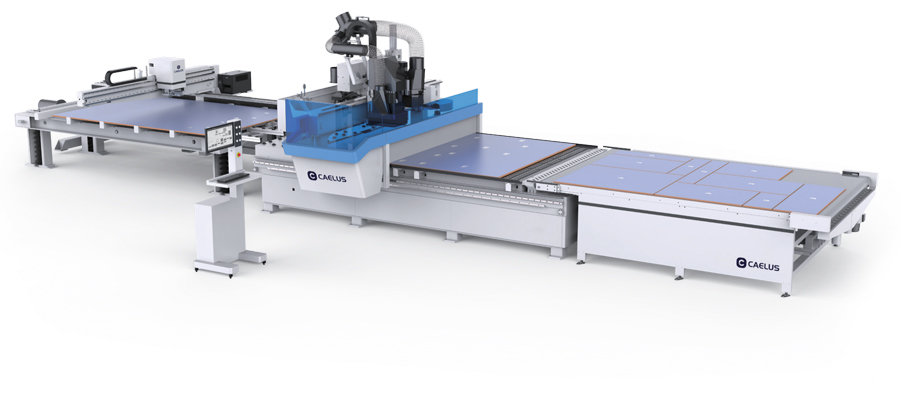
Choosing a wood CNC machine is not a matter of buying the largest table or the highest spindle rating. For a furniture factory, the useful machine is the one that removes the longest delay in the actual production flow.
That delay may occur while cutting full sheets, identifying parts for edge banding, changing tools, drilling connector holes, or turning panels to reach another face. Start there. A faster router cannot remove a drilling queue, and a drilling center cannot improve sheet yield or part identification after cutting.
Quick Selection Guide
| If this is slowing production |
|
Why it fits |
| Full-sheet cutting, grooving, nesting, labelling | CNC nesting machine
|
It processes optimized sheet layouts and can carry part information into later stages |
| Hinge holes, dowel holes, connector holes, horizontal holes, panel turning | CNC six-sided drilling center | It processes multiple panel faces with less manual repositioning |
| Multi-tool doors and mixed flat components | ATC CNC router | It reduces repeated manual tool changes within a program |
| Queues at cutting and drilling |
|
It addresses two linked constraints rather than moving the queue downstream |
For cabinets, wardrobes, office furniture, and custom panel furniture, this process-first approach is more useful than comparing generic feature lists.
1. Define What the Machine Must Process
"Wood CNC machine" covers very different factory needs.
Before requesting quotations, prepare three representative parts:
- A common component
- A difficult custom part
- The largest regular panel
For each part, list the following:
- Material and thickness
- Maximum dimensions
- Required grooves, profiles, and cut-outs
- Hole diameter, depth, and direction
- Number of tools in the real CAM program
- Required label, barcode, or order information
This avoids specifying a machine for the average part while relying on workarounds for critical exceptions.
Match the Working Area to Real Panels
Many panel-furniture factories work with 1220 × 2440 mm boards. Confirm the actual X, Y, and Z machining range, usable vacuum area, zone layout, and loading clearance. A machine can accept a full sheet but still struggle with small nested components.
2. Choose Nesting When Cutting and Part Flow Are the Problem
A CNC nesting machine is suited to a factory that loses time before or immediately after cutting. Typical signs include:
- Operators mark sheets or identify parts by hand
- Tool changes interrupt repeated routing and drilling
- Custom orders become difficult to sort after cutting
Nesting works from a complete sheet. It can optimize part placement, cut profiles, route grooves, complete selected drilling, and apply labels. The key benefit is retaining part data for edge banding, drilling, and assembly.
What to Check on a Nesting Machine
| Check | Why it matters | Question to ask |
|---|---|---|
| Vacuum hold-down | Prevents panel movement and small-part scrap | How are zones isolated when parts do not cover the whole table? |
| Tool changing | Reduces stops on multi-tool programs | How many distinct tools do our actual programs use? |
| Labelling | Supports sorting and later processes | When is the label printed and how is part data transferred? |
| Software workflow | Connects design files to production | Is the post-processor confirmed before installation? |
| Loading and unloading | Affects usable output, not only cutting speed | Does the factory layout support safe material movement? |
Choose ATC when real programs repeatedly need separate tools for profiling, grooves, drilling, and finishing.
3. Choose Six-Sided Drilling When Hole Processing Is the Problem
After cutting, the bottleneck often shifts to shelf-pin rows, hinge cups, dowel holes, connector holes, and horizontal holes.
Evaluate six-sided drilling when panels are repeatedly turned, hole positions are manually located, or drilling delays assembly. "Six-sided" covers the top, bottom, and four edges, processed in a programmed sequence. The benefit is fewer positioning steps and more consistent references.
Use Published Specifications as a Fit Check
CAELUS D5S provides an example of the information that should be matched to your order mix. Its published drilling layout includes two upper blocks with 26 vertical and 18 horizontal positions, plus one lower block with nine vertical positions. The stated maximum drill diameter is 35 mm and the maximum processing depth is 45 mm.
The published panel range is 200 to 2800 mm long, 50 to 1220 mm wide, and 9 to 60 mm thick. This is not a substitute for reviewing real parts. It is a useful first screen for whether the panel size, thickness, and hole requirements fit the configuration.
4. Do Not Choose by Axis Count Alone
| Machine type |
|
|
| 3-axis router | Flat cutting, grooves, basic drilling, 2D and 2.5D work | Does not automatically solve edge and multi-face drilling |
| ATC router | Repeated multi-tool routing on flat parts | ATC alone does not create an automated nesting workflow |
| 4-axis or rotary machine | Legs, posts, curved parts, decorative solid-wood work | May add little value for standard flat cabinet panels |
| CNC nesting machine | Sheet optimization, cutting, labels, part flow | Does not replace dedicated multi-face drilling in every factory |
| Six-sided drilling center | Top, bottom, edge, and horizontal-hole processing | Does not replace full-sheet cutting and nesting |
5. Check the Conditions Around the Machine
Workholding and Machine Stability: Clean cuts and accurate holes depend on rigidity, positioning, tooling, panel support, and clamping. For nesting, check vacuum loss, spoilboard wear, dust, cutter pressure, and the small-part strategy.
Software and Part Data: Confirm that the controller fits the CAD/CAM, nesting, labelling, barcode, and drilling workflow. Settle post-processors, tool numbers, labels, and file names before commissioning.
Utilities and Layout: Confirm electrical supply, compressed air, dust extraction, installation access, maintenance room, and panel movement. D5S published data lists 0.6 MPa air pressure, 450 L/min air consumption, and 9,540 m³/h dust-collection air volume. Verify the selected model against local requirements.
6. Test the Machine With Your Own Parts
Use your materials and production files, not only a standard demonstration. Send the three representative parts, together with:
- Material type and thickness
- Required hole directions and edge-banding notes
- Typical order quantity
- Current software files or drawings
- Required output information for the next process
During the test, check the points below.
| Test point |
|
| Part quality | Edge finish, hole position, and panel support |
| Program flow | Tool sequence, processing path, and remaining manual steps |
| Data flow | Label accuracy, barcode use, and file transfer |
| Capacity | Cycle-time estimate for your own order mix |
| Operator workload | Loading, unloading, panel turning, and sorting tasks |
7. Compare Total Cost, Not Only the Quote
Include tooling, vacuum, dust extraction, air, electrical preparation, software, freight, installation, training, maintenance, spare parts, and downtime. Measure hours lost to panel turning, tool changes, part identification, rework, and waiting. This is the baseline for the investment.
FAQ
Q1. What is the best wood CNC machine for cabinet production?
A: Choose nesting for full-sheet cutting, labels, and part flow. Choose six-sided drilling for multi-face and horizontal-hole constraints.
Q2. Can a nesting machine replace a six-sided drilling center?
A: Not in every factory. Nesting can complete selected drilling, but dedicated equipment suits frequent multi-face and horizontal holes.
Q3. Is an automatic tool changer necessary?
A: Use ATC when real programs repeatedly use several tools. Count unique tools, not machining operations.
Q4. What should be sent before asking for a quote?
A: Send panel drawings, materials and thicknesses, daily output, hole patterns, existing software, current equipment, available utilities, and a simple factory layout.
Conclusion
The right wood CNC machine reduces handling, uncertainty, and waiting in the workflow you already operate. Define the parts, identify the bottleneck, test real programs, and verify the connection to edge banding, drilling, sorting, and assembly.
For a factory-specific recommendation, share representative drawings, panel sizes, material ranges, daily output, hole patterns, software information, and layout details. CAELUS can help evaluate whether CNC nesting, six-sided drilling, or a connected panel-furniture solution is the practical next step.