

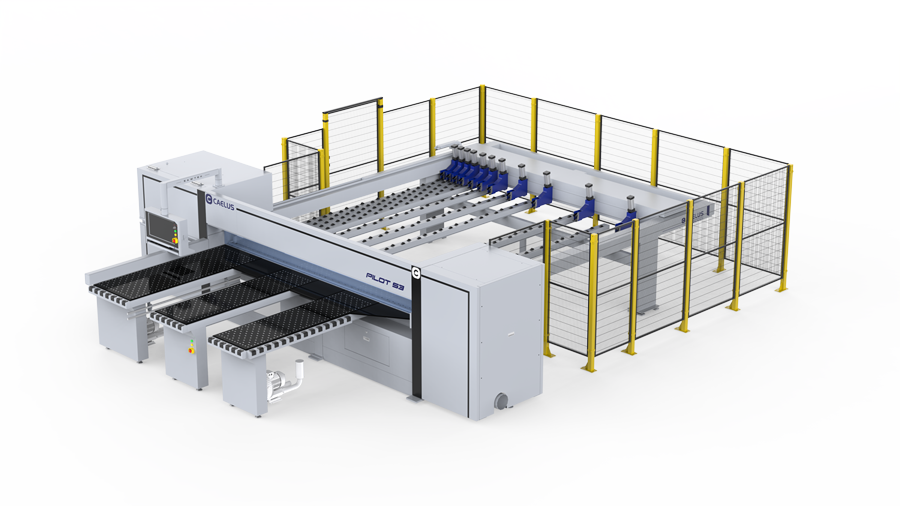
Installing a CNC panel saw successfully starts before the machine is delivered. Your factory needs enough room for panel movement, safe delivery access, stable utilities, effective dust extraction, and a workflow that connects cutting with the next production stage.
The most reliable approach is to confirm the final layout and machine-specific technical requirements before preparing the site. Caelus can help furniture manufacturers evaluate the required machine configuration and planning information before installation.
What Does a CNC Panel Saw Installation Involve?
A CNC panel saw installation is a factory-readiness project, not just machine placement. The goal is to have the saw cut real production panels safely and reliably after commissioning.
- Site preparation: Confirm the layout, delivery route, floor condition, and clear working areas.
- Utility readiness: Prepare the confirmed electrical supply, compressed air, dust extraction, and required data connections.
- Machine positioning: Allow space for full-size panels, cut-part handling, operators, and service access.
- Commissioning: Complete professional installation, safety checks, test cuts, and operator handover.
Requirements vary with the CNC panel saw configuration. A standalone machine has different needs from a rear-loading system linked to panel storage, automatic labeling, or downstream edge banding and drilling.
CNC Panel Saw Installation Requirements at a Glance
Use this checklist before confirming delivery. Exact values for power, air, extraction, weight, and clearances must come from the approved machine specification and layout drawing.
| Area | Confirm Before Delivery | Why It Matters |
|---|---|---|
| Layout | Machine footprint, panel flow, operator and service space | Prevents blocked loading and maintenance |
| Delivery | Doors, aisles, ceiling clearance, rigging route | Ensures the machine can reach its final position |
| Floor | Condition, levelness, and load capacity | Supports stable installation and cutting accuracy |
| Utilities | Electrical power, compressed air, dust extraction, and data | Allows safe commissioning and reliable operation |
| Automation | Loading, labeling, storage, and downstream interfaces | Avoids costly layout changes later |
1. Plan the Right Location and Full Production Footprint
A CNC panel saw needs space to process panels, not merely space to stand. Plan the location around the entire material journey: raw sheets in, cut parts out, then onward to edge banding, drilling, sorting, or assembly.
| Space Zone | What to Allow For |
|---|---|
| Machine zone | The confirmed saw footprint and control area |
| Material zone | Full-size panel loading, staging, and cut-part removal |
| People zone | Safe operator movement, inspection, and emergency access |
| Service zone | Cleaning, blade service, electrical work, and maintenance |
Check these points before fixing the location:
- Map how full panels move from storage to the saw.
- Keep columns, doors, ducts, and electrical cabinets out of travel paths.
- Reserve a defined area for cut parts before the next process.
- Allow room for forklifts, trolleys, or automatic loading equipment where used.
- Check whether future storage or rear loading will need additional space.
Practical tip: A compact layout can become a daily bottleneck if operators cannot load sheets, remove parts, or reach service areas without crossing the material flow.
For furniture factories, the best panel saw factory layout moves panels forward from storage to cutting, then to edge banding and drilling, without unnecessary handling or return travel. Explore the avail CNC panel saw solutions before finalizing the layout.
2. Check Delivery Access Before the CNC Panel Saw Ships
A machine can be suitable for your production and still cause delays if it cannot reach its planned location. Check access before shipment, not on delivery day.
- Unloading area: Confirm space for the delivery vehicle and unloading equipment.
- Building entry: Measure door width and height against packaged machine sections.
- Internal route: Check aisles, turns, columns, level changes, and ceiling clearance.
- Rigging plan: Confirm whether a forklift, crane, or professional rigger is required.
- Final location: Clear and mark the installation area on the approved layout.
Agree early on who provides lifting information, checks the route, arranges qualified unloading personnel, prepares utility points, and coordinates delivery with commissioning.
3. Prepare Electrical Power, Compressed Air and Data Connections
Utilities should be confirmed before the CNC panel saw arrives. Do not estimate requirements from the main saw motor alone: the complete configuration may include controls, pneumatic devices, air-flotation tables, labeling, loading equipment, or automation interfaces.
Electrical Power
- Confirm voltage, frequency, phase, disconnect location, and cable route.
- Confirm capacity for selected options and connected automation.
- Use a qualified local electrical professional for installation work.
Compressed Air and Data
- Confirm machine-specific air pressure, consumption, connection position, and air-quality requirements.
- Check whether the existing compressor can support simultaneous equipment demand.
- Plan network access where cutting optimization, barcode labeling, storage, or MES/ERP data is used.
- Clarify responsibility for software setup, operator access, and data import.
4. Design Dust Extraction as Part of the Installation Plan
Dust extraction should be planned before the CNC panel saw is positioned. Retrofitting ducts after installation can restrict service access, obstruct panel movement, and add unnecessary cost.
Confirm the following before commissioning:
- Saw dust-connection points and required extraction data;
- Collector capacity for the confirmed machine and expected cutting volume;
- Duct routing, supports, cleaning access, and emergency routes;
- Clearance between ductwork, moving equipment, walkways, and maintenance areas;
- Cleaning and filter-maintenance responsibilities.
| Avoid | Use Instead |
|---|---|
| Selecting a collector only by saw motor power | Match extraction to the supplier's confirmed machine requirement |
| Routing ducts after installation | Include ducts in the approved layout |
| Blowing accumulated dust into the work area | Use suitable extraction and planned cleaning procedures |
| Treating extraction as a comfort feature | Treat it as a production, maintenance, and safety requirement |
Local exhaust ventilation should control wood dust at the source. Review the final dust-collection design against machine documentation and applicable local safety requirements.
5. Prepare the Floor and Installation Environment
A CNC panel saw needs a stable, accessible installation area. The final floor requirements depend on the selected model, options, and approved layout.
- Confirm that the floor is suitable for the confirmed machine and handling equipment.
- Keep the area clean, dry, and ready for professional positioning and alignment.
- Allow technicians access to electrical cabinets, pneumatic connections, and service points.
- Check that storage racks, nearby machines, and dust ducts do not interfere with the installation zone.
- Confirm requirements before pouring foundations, moving utilities, or installing permanent barriers.
| Question | Why Ask It |
|---|---|
| Is the saw standalone or part of an automated line? | Storage and loading modules may change the layout |
| Has the final model and option list been confirmed? | Requirements vary by configuration |
| Is an installation drawing available? | It identifies placement and connection points |
| Are local building requirements applicable? | A qualified local professional should verify them |
6. Installation, Calibration and Commissioning
Once the site and utilities are ready, the CNC panel saw can be positioned, connected, checked, and prepared for production. Industrial equipment should be installed and commissioned under the supplier's approved procedure.
- Positioning and connection: Place the machine according to the layout and complete confirmed utility connections.
- Mechanical and safety checks: Verify moving systems, guards, emergency stops, and access areas before production begins.
- Calibration and empty-run testing: Check controlled movements, positioning, clamping, and control functions without material.
- Test cuts and handover: Use actual panel materials and representative cut lists to review dimensions, edge quality, labels, and downstream flow.
| Acceptance Area | What to Confirm |
|---|---|
| Utilities | Power, air, extraction, and network connections are ready |
| Safety | Guards, emergency stops, safety zones, and lockout procedures are reviewed |
| Machine operation | Motion, positioning, clamping, and controls operate normally |
| Cut quality | Test parts meet agreed size and edge-quality expectations |
| Workflow | Labels and cut parts move correctly to the next process |
| Training | Operators understand normal operation and daily checks |
Prepare your common panel types, cutting patterns, labeling requirements, and downstream workflow before commissioning. This makes acceptance testing more relevant than a generic demonstration.
7. Common Problems That Start Before Production
Many cutting issues are not caused by the CNC panel saw itself. They begin with an incomplete layout, unverified utilities, weak material-handling flow, or a rushed commissioning process.
| Common Problem | Likely Early Cause | Preventive Action |
|---|---|---|
| Panels are difficult to load | Insufficient infeed space or poor staging | Map the full panel path before fixing the saw location |
| Cut parts accumulate around the saw | No outfeed, sorting, or downstream route | Reserve a cut-part zone linked to the next process |
| Accuracy changes during batches | References, support, or setup checks are not verified | Use actual materials and cut lists during commissioning |
| Dust affects visibility or machine movement | Extraction was added after layout approval | Confirm duct routing and cleaning access before installation |
| Unexpected downtime | Daily cleaning and inspection duties are unclear | Include basic checks in operator handover |
After handover, keep work surfaces and guide areas clean, review blade condition and cutting programs, and report changes in cut quality before errors accumulate.
8. Plan for Automation and Future Expansion
A standalone CNC panel saw can improve cutting speed and repeatability. If your factory expects higher order volume or future automation, reserve space and connections before installation.
| Setup | Plan Early |
|---|---|
| Standalone saw | Manual loading, cut-part handling, storage, and trolley paths |
| Rear-loading saw | Rear clearance and loading-system interfaces |
| Saw with panel storage | Storage footprint, transfer path, controls, and safety zones |
| Connected production line | Labels, buffer space, part identification, and data transfer |
Aurora S6 CNC panel saw can be configured with features such as automatic labeling, storage-system connection, linear motor drive, and rear-loading options. Planning these interfaces early can make a later automation upgrade more practical.
9. Information to Send Caelus for a Pre-Installation Review
Providing complete factory information early helps create a CNC panel saw layout that fits your production instead of relying on a generic estimate.
Send these details:
- A factory floor plan with dimensions, doors, columns, and existing equipment;
- Photos or video of the delivery route and proposed installation area;
- Available electrical, compressed-air, and dust-collection information;
- Panel sizes, materials, thickness range, and expected cutting volume;
- Your loading method: manual, front loading, rear loading, or storage system;
- Downstream equipment, including edge banders, drilling machines, sorting, or assembly areas;
- Your preferred installation and production-start timeline.
FAQ
Q1. How much space does a CNC panel saw need?
A: Include the machine, full-panel loading, cut-part removal, operator movement, service access, and any connected automation. Use the approved layout, not machine dimensions alone.
Q2. Does a CNC panel saw require three-phase power?
A: Many industrial machines do, but the required voltage, phase, disconnect arrangement, and total demand depend on the confirmed model and options.
Q3. Can I use my existing dust collector?
A: Possibly, after checking its capacity, duct routing, connection points, and ability to support the confirmed saw and other equipment operating at the same time.
Q4. Does the floor need special preparation?
A: Floor condition, levelness, load capacity, and any foundation work depend on the final machine layout. Confirm requirements before altering the site.
Q5. Can panel storage or rear loading be added later?
A: It may be possible, but expansion is easier when the original layout reserves space, utility routes, safety zones, and data interfaces.
Q6. What should I send for a layout review?
A: Send a factory layout, delivery-route details, available utilities, panel sizes, production needs, loading method, and downstream equipment plan.
Conclusion
CNC panel saw installation requires more than a machine footprint. Prepare a clear delivery route, stable floor, adequate loading and service space, electrical power, compressed air, dust extraction, and safe access. Plan panel flow, commissioning, and future storage or automation before delivery. Final requirements should follow the approved machine layout and technical specification. This prevents avoidable delays, protects cutting accuracy, and supports handoff to edge banding, drilling, and assembly